



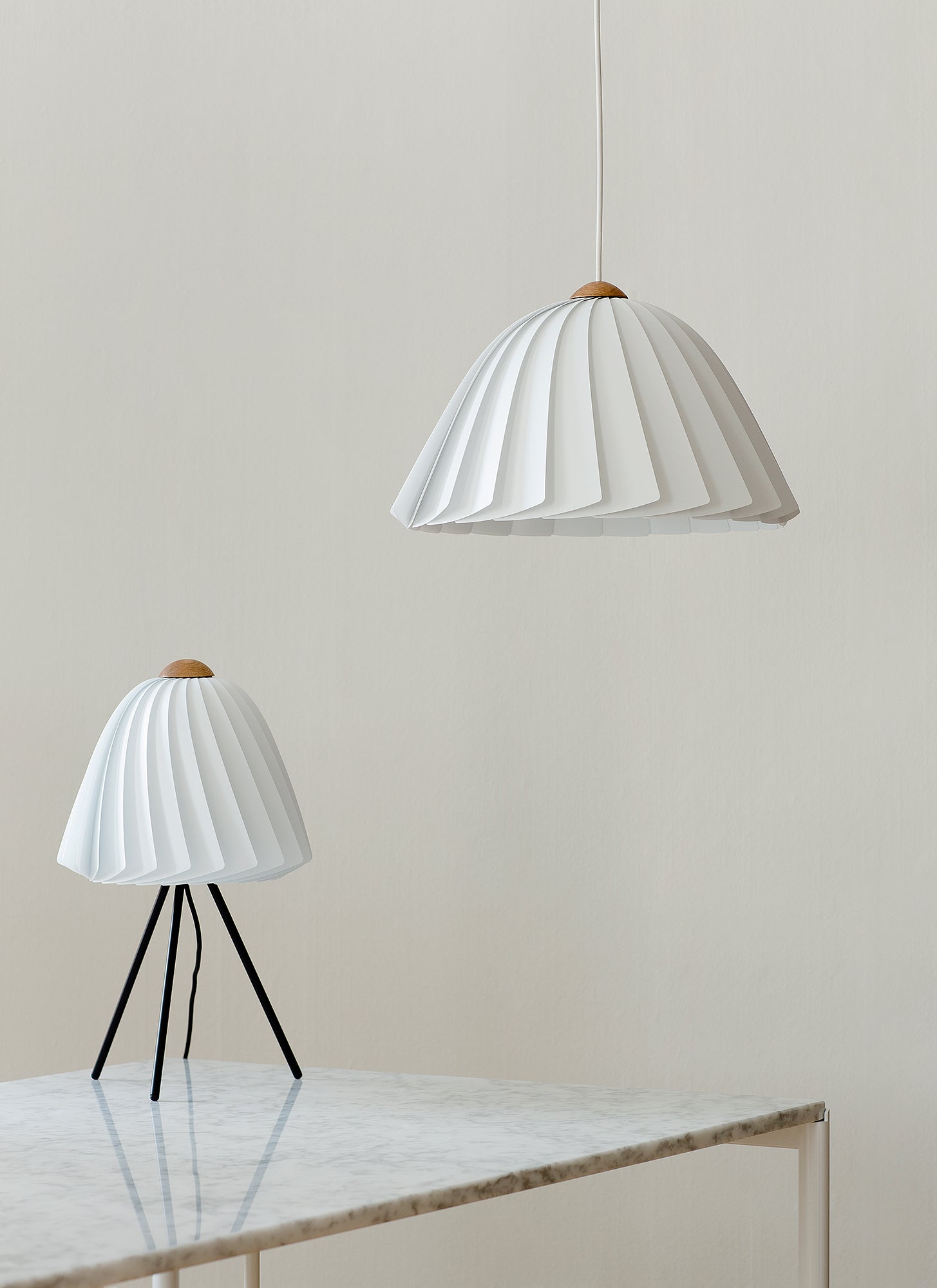
Ballet is a range of lamps in which gravity plays a crucial role in the design. It was designed by the architect Poul Christiansen and inspired by everything from an open book to the petals of a flower.
Imagine an open book lying on a table in front of you. Its spine is facing downwards. The pages fall down to both the right and left, forming, when viewed from the side, a sort of arch. Or a crescent moon, if you like.
Can you picture it? Then you can see what Poul Christiansen saw when he first came up with the idea for the Ballet series.
Poul Christiansen trained as an architect. But even whilst a student, he began to take an interest in the various ways in which materials can be folded. He folded and folded, and gradually discovered the magic of folding along mathematical curves rather than straight lines.
Folding along curves was unprecedented in Danish design, and that is precisely why Poul Christiansen was fascinated by the technique. In fact, he was so fascinated that he ended up using it to design some of Le Klint’s most popular lamps, such as the Model 172 pendant.
The Ballet series is inspired by nature
Ballet is a lamp series designed by Poul Christiansen for Spring Copenhagen. It comprises a pendant and a table lamp, both featuring slats suspended in an arc around the bulb, like an open book with pages fanning out.
The arc is the result of the rigidity of the material – polypropylene – and the influence of gravity. And it was precisely nature and its laws that provided a major inspiration for the further development of the lamps’ design.
“The shape is almost created by nature. Both because it is gravity that gives the lamps their shape, and because the lamps’ construction resembles the way a flower is put together,” says Poul Christiansen.
Both the table lamp and the pendant lamp have a wooden centre. The lamps’ slats, or ‘petals’, are all attached to the centre – or the ‘bud’. In this way, the design resembles the structure of a flower. At the same time, the lamps arrive flat – but when you lift them by the cord, their slats fall down and form a parabolic shape, familiar from old metal pendant lamps.
In this way, gravity plays its part. And if you use a little imagination, you might also glimpse the inspiration drawn from a particular animal in the design. Namely, the jellyfish. In the way the slats move – and particularly in the table lamp, whose legs can be associated with tentacles.
Just the right moment
The idea for the series had been brewing in Poul Christiansen’s mind for a long time. But it was as if the right opportunity to bring it to life hadn’t quite presented itself. So when the chance arose, he knew that this was precisely the design he wanted to realise.
“The first sketch models had paper slats and a string as the cord. When you pulled the string, the flat rosette of slats rose up and took on a beautiful parabolic shape. Then I met Claus [Nielsen], who fell in love with the idea, and we decided to develop it using the right material. It took 20–30 attempts before the stiffness of the material – and thus the shape – was just right,”
says Poul Christiansen.
Classic Danish design
The lamp series is Spring Copenhagen’s take on a classic. A series of fine Danish design, classic and timeless in style, with a look that suits most homes.
“A lamp doesn’t need to stand out much or be complicated to become a classic,” says Poul Christiansen. “Just look at the rice paper lamp. It’s simple and isn’t considered anything special, yet it has survived for several hundred years.”
And perhaps that is precisely why: because it is simple and timeless. Just like the parabolic shape of the Ballet lamps. And who knows? Perhaps Ballet will still be lighting up our living rooms in 50 years’ time.
FACT: How the Ballet lamps got their name
The name only came about once the lamp was finished.
Poul Christiansen looked at the finished design and suddenly saw something new: a ballet skirt. The waist where the skirt is attached. The way it folds down. And the sweep of the skirt as the ballerina performs her pirouettes.
And suddenly, the lamp could be called nothing else: ‘Ballet’ was born.


